403 West Windsor Road, Champaign, IL 61820.

A Permanent Solution Because Every Smile Is Worth Saving
Losing a tooth doesn't mean settling for a diminished smile or struggling with the way you chew and speak. Dental implants are the most natural-looking, longest-lasting tooth replacement option available and at W. Eric Martin, DDS, PC in Champaign, IL, we use guided implant technology to make the process more precise, more comfortable, and more efficient than ever before. Whether you've recently lost a tooth or have been living with a gap for years, an implant could give you back the smile and function you deserve.
Schedule an Implant Consultation
What Are Guided Dental Implants and How Do They Work?
A dental implant is a small titanium post that is surgically placed into the jawbone to serve as an artificial tooth root. Once it integrates with the surrounding bone, a custom-crafted artificial tooth, called a crown, is secured on top, giving you a replacement that looks, feels, and functions just like a natural tooth.
At W. Eric Martin, DDS, PC, we take implant placement a step further with guided implant surgery. Unlike the traditional freehand technique, guided surgery uses advanced computer software and precise digital planning before a single incision is made. This allows our team to map out the exact position, angle, and depth of the implant with a level of accuracy that simply isn't possible with the naked eye alone.
The result: a more predictable outcome, a faster procedure, and in many cases the ability to place the implant without incisions or stitches at all.
Why Guided Implant Technology Makes a Difference
The guided approach to dental implant placement represents a significant advancement over traditional freehand surgical techniques and the benefits are tangible for patients.
With guided surgery, your entire implant procedure is mapped out digitally before treatment begins. Our dentist uses computer software to plan the precise placement of your implant based on detailed 3D scans of your jawbone, teeth, and anatomy. A custom surgical guide is then fabricated from that plan, ensuring the implant is placed exactly where it needs to be.
Here's what that means for you:
- Greater precision — The implant is placed at the exact angle, depth, and position planned digitally, reducing the margin for error.
- Less invasive — Because placement is guided with such accuracy, incisions and stitches can often be avoided entirely, a significant advantage over traditional techniques.
- Faster procedure — Guided surgery is more efficient, which typically means less time in the chair.
- Shorter recovery — Less tissue disruption means less post-operative discomfort and a faster return to normal activity.
- More predictable outcomes — Precise planning means fewer surprises and a more consistent, reliable result.
The Three Phases of Guided Dental Implant Treatment
Implant Placement
Using a precisely fabricated surgical guide created from your digital scans and treatment plan, our dentist places the titanium post into the jawbone at the exact predetermined position. The guided approach means greater accuracy and, often, a less invasive procedure with reduced discomfort.
Osseointegration
Over the following weeks to months, the implant undergoes osseointegration — the process by which the titanium post fuses with the surrounding jawbone to create a stable, permanent foundation. This integration is what gives implants their exceptional strength and longevity. During this phase, a temporary restoration keeps your smile looking complete.
Crown Placement
Once osseointegration is complete, a custom-crafted crown is permanently secured onto the implant. The crown is designed to match the color, shape, and size of your surrounding teeth — completing your smile with a result that looks and feels completely natural.
All-on-4 & All-on-X
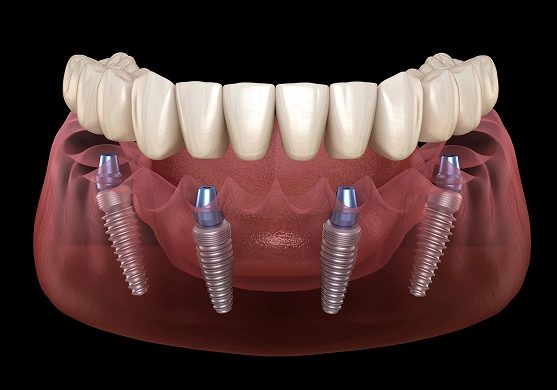
If you are missing most or all of your teeth, or facing full extractions, All-On-4 and All-On-X implants offer a life-changing alternative to traditional dentures. Rather than replacing each tooth individually, an entire arch of teeth is supported by just four (or more) precisely angled implants, allowing Dr. Martin to place a full fixed bridge the very same day as surgery.
What Is the Difference Between All-on-4 and All-on-X?
All-On-4 uses exactly four implants per arch, two placed straight in the front and two angled toward the back, to maximize contact with available bone without the need for grafting in most cases. All-On-X (sometimes called All-On-6) simply means six or more implants are used when additional support is needed, such as for patients with greater bone density variation or a wider arch. Both solutions deliver a full, non-removable set of teeth anchored securely in your jaw.
Am I a Candidate for All-On-4 / All-On-X?
Most adults who are missing all or most teeth in one or both arches or who are facing extractions due to decay, gum disease, or failing bridges are candidates. Good overall health and adequate jawbone (or bone that can be prepared) are the primary requirements. During your consultation, our doctors will review your health history, discuss your goals, and determine the next steps for creating a personalized treatment plan.
Why Dental Implants Are the Gold Standard for Tooth Replacement
When it comes to replacing a missing tooth, you have options. Bridges, partial dentures, and implants each have their place. But implants offer advantages that no other solution can match:
- They're permanent. Once integrated, a dental implant is a fixed, stable part of your mouth. No removing it at night. No worrying about it slipping or clicking.
- They look and feel like natural teeth. The crown placed on top of an implant is custom-designed to blend seamlessly with your surrounding teeth. Most people will never know it's there — including you, once you've adjusted.
- They preserve your jawbone. Every other tooth replacement option sits on top of the gum. An implant replicates the function of a natural tooth root, stimulating the jawbone beneath it and preventing the bone loss that inevitably follows tooth loss.
- They protect your surrounding teeth. Bridges require reshaping the teeth on either side of a gap. Implants stand entirely on their own. No modification to neighboring teeth required.
- They're built to last. With proper care, dental implants can last a lifetime. Compare that to bridges, which typically need replacement after 10 to 15 years, and the long-term value of an implant becomes clear.
Find Out If a Dental Implant Is Right for You
Not every patient is an immediate candidate for dental implants, factors like bone density, gum health, and overall oral health all play a role. The best way to find out if an implant is the right solution for your situation is to schedule an assessment with our team. We'll evaluate your unique needs, walk you through your options, and build a custom treatment plan that's worth smiling about. Call W. Eric Martin, DDS, PC in Champaign, IL today, a better smile might be closer than you think.
Schedule an Appointment
Frequently Asked Questions About Dental Implants
Am I a good candidate for dental implants?
Most adults in good general health who are missing one or more teeth are potential candidates for dental implants. Key factors include having sufficient jawbone density to support the implant, healthy gum tissue, and no uncontrolled conditions that could interfere with healing. We'll assess all of these during your consultation and let you know exactly where you stand.
How long does the dental implant process take?
The full implant process — from placement through final crown placement — typically takes several months, with the majority of that time dedicated to osseointegration. The actual placement procedure itself is relatively quick, particularly with guided technology. We'll walk you through a realistic timeline at your consultation based on your specific situation.
Does getting a dental implant hurt?
The placement procedure is performed under local anesthetic, so you won't feel pain during the surgery. Some soreness and mild swelling in the days following placement is normal and typically manageable with over-the-counter pain relievers. Most patients are pleasantly surprised by how tolerable the recovery is — particularly with guided surgery, which minimizes tissue disruption.
How long do dental implants last?
With proper care — regular brushing, flossing, and routine dental checkups — dental implants can last a lifetime. The crown placed on top may eventually need replacement after 15 to 20 years of normal wear, but the implant itself is designed to be a permanent solution.
What happens if I don't have enough jawbone for an implant?
Bone loss is common after tooth loss, and some patients don't have sufficient bone density for immediate implant placement. In these cases, a bone grafting procedure can rebuild the necessary bone volume before the implant is placed. We'll assess your bone structure during your consultation and let you know if grafting is needed.
How do I care for a dental implant?
Care for your implant the same way you care for your natural teeth — brush twice daily, floss daily, and attend regular professional cleanings and checkups. Because the implant is integrated into the jawbone, it doesn't decay the way a natural tooth can — but the surrounding gum tissue still needs attention to stay healthy.
Can a dental implant be used to support a bridge or denture?
Yes. While a single implant typically supports a single crown, implants can also be used to anchor bridges spanning multiple missing teeth, or to stabilize a full denture — dramatically improving retention and comfort compared to traditional removable dentures. Ask us about implant-supported restoration options during your consultation.
Is the cost of dental implants covered by insurance?
Coverage for dental implants varies widely by insurance plan. Some plans offer partial coverage; others exclude implants entirely. Our team will verify your benefits before your appointment and walk you through any out-of-pocket costs. We also offer CareCredit financing for patients who need flexible payment options.
